North Friesland Blog Information on current topics
With around 120 participants, a diverse program, and discussions that continued even after the event ended, windWERT 2026 in Kiel focused on current issues in wind energy. The topics ranged from regional planning and financing to permitting processes and AI, as well as technical innovations, regional value creation, and offshore wind.
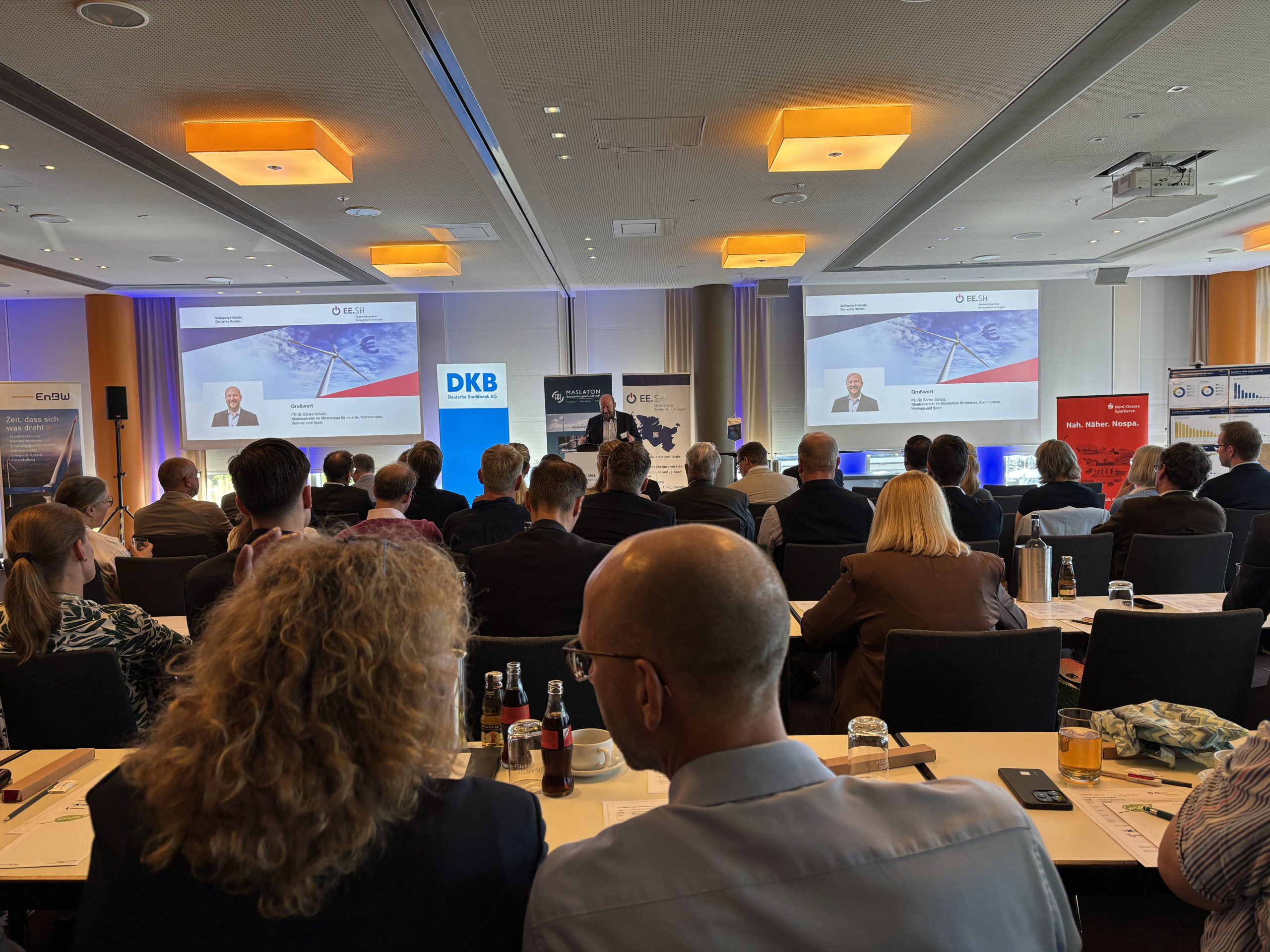
On August 25, 2026, EE.SH brought together representatives from the wind industry, politics, the financial sector, and other areas of the energy transition at the ATLANTIC Hotel in Kiel for the 16th windWERT event. The event’s goal was not only to highlight current developments but also to take a closer look at what they mean for projects, companies, and the continued expansion of wind energy.
PD Dr. Sönke Schulz, State Secretary at the Ministry of the Interior, Local Government, Housing, and Sports of the State of Schleswig-Holstein, delivered the opening remarks. In his opening remarks, he addressed, among other topics, regional wind energy planning. Expansion targets play just as important a role in this context as legal certainty, the balancing of interests and burdens, and the protection of various concerns.
For Schleswig-Holstein in particular, the issue of land-use planning is directly linked to the further expansion of wind energy. It became clear early on at windWERT that the speed at which new projects can be developed depends not only on technology or willingness to invest, but also on the planning framework.
The financing of wind energy projects is also changing. During the financing panel discussion moderated by Dr. Matthias Hüppauff, Heiko Runge (NOSPA), Norman Hertel (VR Bank), and Philipp Präkels (DKB) discussed the financial sector’s perspective on current projects.
The discussion focused on the conditions under which wind energy projects can remain financially viable today and in the future. This is because project development, regulatory requirements, revenue models, and investment decisions are becoming increasingly intertwined.

Prof. Dr. Martin Maslaton provided further insight into the industry’s broader context. In a presentation titled “Legal Issues in Wind Energy in Schleswig-Holstein—Energy as a Means of Defending Political Interests?!,” he analyzed current legal and energy policy developments.
In the afternoon, Maslaton also took part in a panel discussion moderated by Nicole Weinhold, editor-in-chief of ERNEUERBARE ENERGIEN. Together with Joschka Knuth, Lisa Hebenstreit, Melanie Jessen, Stephan Frense, and Torsten Levsen, they engaged in a very lively discussion. Different perspectives from politics, grid operations, and the wind industry came into direct contact, ensuring that individual answers repeatedly gave rise to new questions and comments.
Jens Kulenkampff from digital@work demonstrated exactly how digitalization can help accelerate projects. His topic: the data-sovereign application of AI, using due diligence and approval processes as examples.
It is precisely in this area that large volumes of documents must be reviewed, structured, and evaluated. AI agents make it possible to organize such processes more efficiently. This brings into focus an area that is easily overlooked in the discussion about AI and the energy transition: It’s not just plants, grids, and forecasts that can become more digital. The processes leading up to the completion of a project also offer significant potential.
In her presentation titled “The Next Level of Wind Energy,” Melanie Jessen, managing director of Windtestfeld-Nord GmbH, focused on new technologies and their testing under real-world conditions. The wind test field is now entering a new phase of innovation and creating opportunities for further ideas to be tested in practice.
Gerd Kroll from BeWind then demonstrated what technical advancements can look like in practice by showcasing the integration of a pitch bearing unit (PBU) into a Senvion 3.6M140 in Südermarsch. Behind this lies a question central to the industry: How can the performance of wind turbines be improved without simply making individual components larger and larger?
René Ohm of Regiogröön demonstrated that wind energy is not just a matter of generation. His presentation covered topics ranging from self-supply to community-based electricity, and thus explored models in which generation and consumption are more closely integrated at the regional level.
This opens up an important opportunity for regions with high levels of wind power generation: Local residents and businesses can not only look out at the wind turbines in their area, but also benefit more directly from the energy generated and the associated economic value.
Infrastructure, too, can be reimagined. Marcus Müller of geodesia demonstrated how data and power grids can be laid in parallel for renewable energy projects and how lessons learned from professional fiber-optic network deployment can be applied to this endeavor.
This directly links the physical energy infrastructure with the digital infrastructure required for the operation, control, and interconnection of an increasingly complex energy system.
Roger Müller of trend:research provided further insight into the value chain. Drawing on the study “Value Creation in the Offshore Wind Energy Sector in Germany,” on which he himself collaborated, he examined the economic impacts of the offshore wind industry.

After a day of presentations and discussions, the windWERT event moved to Deck 8 of the ATLANTIC Hotel in the early evening. With sunshine, a view of Kiel, and a refreshing breeze, the official program gave way to an informal gathering of the Schleswig-Holstein wind energy community.
It is precisely this connection that has defined windWERT for years: bringing current topics of expertise to the stage while also creating a space for participants to explore them further together afterward.
Feedback from the on-site discussions showed that participants particularly appreciated the breadth of topics covered and the exchange of different perspectives. The participants’ written feedback will also be analyzed.
After all, the issues surrounding wind energy are not getting any less complex. This makes it all the more important to have forums where planning, legal matters, financing, technology, infrastructure, and regional economic development are not considered in isolation from one another. windWERT brings these perspectives together.
And after windWERT is before windWERT.
